
Winter Wonderland: 8 Tips for RVing in Cold Weather


Flee to the Sunbelt or Camp in the Cold Weather
It’s fortuitous that I am writing this article now. My last blog post was about snowbirding and heading for the deep south to avoid all the issues that this article highlights. But not everyone can afford to travel to the southern edge of the Sunbelt when the cold weather starts to set in. There are thousands of RVers who live, work, and travel in an RV year-round and many work campers reside in RV parks in every region of the country.
These year-round RVers work on construction sites, infrastructure projects, and in hospitals and schools all over the country. And they don’t have the luxury of fleeing the cold weather as soon as winter starts to settle in, so they need to find ways to cope with the cold weather conditions in their RVs, regardless of where they are parked.
Plan Ahead When Buying an RV
I frequently write about all the things to consider when you’re buying an RV and this certainly is one of those issues. I advise people to understand where, when, and how often, they will be using their RV prior to even starting the shopping process. If you know that you are going to be using your RV as a homebase for work camping, then you should anticipate that you might have to camp in cold weather environments. And knowing that, you can shop for an RV that has a cold weather package already built into it.
These RVs are designed for year around camping in inclement weather conditions. They include extra insulation, double pane windows, extra protection in the undercarriage to guard against frozen pipes, heated tanks, and a powerful furnace. You can also purchase an RV with heated floors for your comfort and that of your pets. Knowing ahead of time that you are going to be camping in inclement weather will help you pick the perfect RV for your specific needs.
Why is Winter Camping in an RV such a Big Concern?
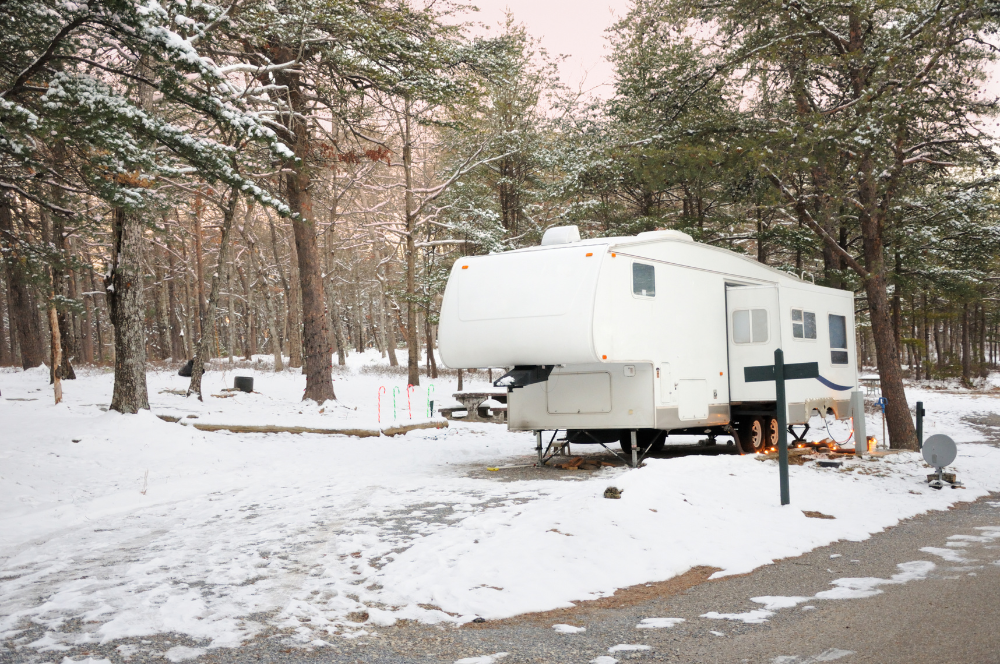
Unlike a fixed residential structure that has layers of insulation and protection from wind and cold temperatures, the living environments in an RV are much more exposed, as are all of the mechanical features in an RV. It’s appropriate that I am writing this article at this time because right now we are personally camping in a very cold environment.
The nighttime temperatures are routinely dropping down into the high teens and low 20s and those cold temperatures are perceptible on the inside of our motorhome. Additionally, it has been sunny but windy and cold throughout the day. When I lived in a house, I wouldn’t have even paid any attention to these temperatures, but living in an RV, I am acutely aware of the cold. Fortunately, we haven’t had any snow or ice, so travel has been safe, but the cold temperatures are more than just an issue of discomfort.
The cold can also adversely affect the operation of an RV and even damage some systems. As an example, our motorhome is equipped with two electric heat pumps, and a propane furnace. Most RVs have both options, however, when the temperature drops to freezing or below the electric heat pumps cease to function, and all of the heat must be provided by the propane furnace.

The furnace is noisy, and more costly to operate, plus it discharges exhaust into the environment so it’s not as clean as the heat pumps. Our work around during the daytime hours is to use electric heaters, but portable electric heaters are not a safe option at night while you’re asleep. They are prone to catching on fire and need to be monitored whenever they’re in operation.
Plumbing is another major concern when camping in an RV in cold weather conditions. Yes, your pipes can freeze in a residential structure but it’s much less likely to occur in a house where the crawlspace is enclosed, and the pipes and plumbing features are surrounded by more insulation. But in an RV cold air circulates 360° around, over and under the RV.
Also, in a brick and mortar residence, you never have to pull in the side of your living room to move your residence to another location. But in an RV large chunks of ice or deep snow can and do accumulate on the top of the slide outs and must be eliminated prior to retracting the walls of the RV. Failing to remove these obstacles can damage the slide outs.
Additionally, the fluid next to the knife valve in your black and gray tanks could freeze rendering the valve temporarily inoperable, and possibly damaging the valve. Also, unless you use a heated freshwater hose, the hose will freeze when the outside temperature drops below 32°. Not only is it inconvenient to not have any freshwater it could damage some part of your plumbing network.
How to Cope with Cold Weather RVing
There are several things that you can do to reduce the negative impact of cold weather camping in an RV and that involves your windows, plumbing, insulation, and protecting the undercarriage of your RV.
Windows
If you were not fortunate enough to buy an RV that was pre-equipped with an all-weather package and heated floors, there are still many things that you can do to manage the difficulties and potential threat of cold weather. First of all, layer up your clothing so that you’re less exposed inside and out of your RV. If your RV is equipped with double pane windows, it will help significantly to reduce the chill on the inside of your RV.
However, if you do not have double pane windows, you can still insulate the inside of the window to reduce the draft and exposure. Unfortunately, covering all the windows can make the RV a little dark and gloomy so for a better mental attitude, you might want to leave at least one or two windows exposed to let in some natural light.
Plumbing
Taking care of the plumbing is another major concern in cold weather. One way to help keep your hoses and plumbing from freezing is to run a small amount of water in the sink all through the night and also use enough water throughout the day to keep the liquid flowing.
On the other hand heated hoses are fully insulated with a hot wrap that plugs into a 20 amp power source and a heated hose will keep your freshwater flowing. If you use a heated hose, you do not need to run water throughout the night but if you do run water through the night, be sure that it is draining into the gray tank and that the gray tank valve is open so that you don’t accidentally overflow a sewage tank.
Insulation
In terms of insulation, you could add a layer of insulation to the undercarriage of your RV to help protect all of the exposed pipes. You could also add insulation to the roof of all of your basements to better insulate the floor on the inside of your RV. It wouldn’t be as good as having a heated floor, but it could help.
Add a Skirt
You can also reduce the amount of exposure to cold weather by blocking off the undercarriage of the RV with a skirt. I have seen skirts made from hay bales, or tarps taped to the side of the RV, or even rigid insulation material. These skirts can look rather crude, but there is an alternative, which is a commercial inflatable bladder system that is made specifically for your RV.
These inflatable bladders fit in the space beneath the RV and the ground, and this is an RV’s version of an enclosed residential crawl space. As a side note, if you add a skirt to your RV, you are also creating an ideal environment for vermin to take up residence in the enclosed space. Therefore, you should check under the RV frequently for signs of skunks, possums, raccoons, rats, or other inhabitants and use the appropriate repellent.
Summary
Winter camping may not be ideal, but it does offer some rich opportunities to experience nature in its various forms. Perhaps you’re an avid snowboarder or skier, and you just need to be close to the snow to enjoy your favorite pastime or you’re a work camper and your work assignment is in a cold part of the country. Either way if you follow some of the simple tips outlined here, you can reduce your discomfort and possibly eliminate any damage to your RV caused by inclement weather.

In-Season RV Maintenance Reminder
11 Steps for Safe RV Storage

RV Dewinterization: 11 Essential Things to Consider