
5 Early Foliage Spotting Fall RV Trips to Book Now

There are hundreds of unique destinations to enjoy while you’re RVing and they’re conveniently scattered across the entire North American continent, so they can be enjoyed by the largest number of RVers with limited travel time. Over the past three decades, I have personally driven a motorhome over 130,000 miles throughout the US and Canada so my recommendations come from my personal experiences. The term early fall RV trips implies leaf peeping that may precede the bulk of the leaf changing season.
Why Fall Color Timing Is So Hard to Pin Down
Prime leaf peeping season is always impacted by regional weather, latitude, and elevation, so pinning down the exact timing for optimal viewing is very difficult. For example, the prime leaf peeping season is generally in October but if you’re traveling high up in the Rocky Mountains or you’re traveling in the Yukon Territory or Northern Ontario the season could start much earlier. Additionally, in some of these locations you might not want to still be there in your RV in October.
So here are five early fall foliage RV trips to work into your travel calendar. Going early makes sense for most of these destinations because of their location and weather. For example, planning a trip to Cape Breton Highlands Park in Nova Scotia to enjoy the wildlife and foliage would be less stressful if you planned to visit in September or before. The park is in Northern Nova Scotia and is quiet wild with some severely steep and curvaceous roadways that are a challenge in any RV even in good weather.
The trip is definitely worth your time and effort but the best time to visit might be before the October leaf peeping season kicks off in the lower 48 states. The same can be said for many of the destinations in the Rocky Mountain States; Wyoming, Colorado, Montana, Utah, Northern Arizona, and New Mexico.
Planning an early fall foliage RV trip to Yellowstone National Park or Glacier National Park will let you enjoy the fall foliage before these parks impose access restrictions due to snow and avalanche risks. Another early fall foliage RV trip could be to Acadia National Park in Maine where the coastal scenery, quaint communities, and fall foliage are well worth the drive to the northeast corner of the country.
My final recommendation for an early fall foliage RV trip is the Columbia Gorge and adjacent fruit loop through Hood River and Mt. Hood, in Oregon.
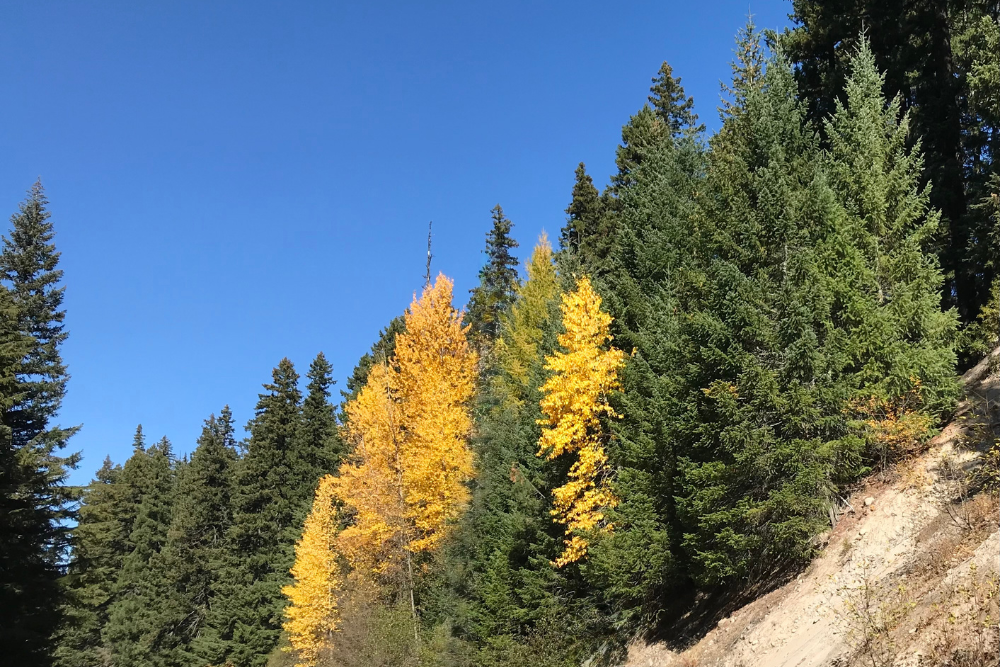
This trip includes a stretch up the north side of Mt. Hood where the Vine Maples change from green to bright red, orange, and yellow and the Tamarac trees (a variety of evergreen conifer tree) turn a bright yellow color and peppers the evergreen forest with bright splashed of color. Like Cape Breton Highlands, the Columbia Gorge / Mt. Hood Loop is subject to severe weather conditions later in the season so scheduling this trip early will be safer in an RV.
Shenandoah Mountains and Luray Caverns, Virginia
Another popular RV leaf peeping destinations is the Shenandoah Mountains in Virginia, where you can also take in the Luray Caverns which is the largest cavern in the eastern US. In this spectacular cave you will see remarkable (almost unbelievable) rock formations, an underground lake, that perfectly reflects the overhead structure of the cave, and an organ attached to the stalactites to amplify the sound. The Shenandoah Mountains borders and overlooks the Shenandoah Valley and offers a beautiful driving experience for over a hundred miles of scenic wonder. The road is RV compatible but wildlife is abundant so drive cautiously.
Bayou Color: New Orleans to Galveston
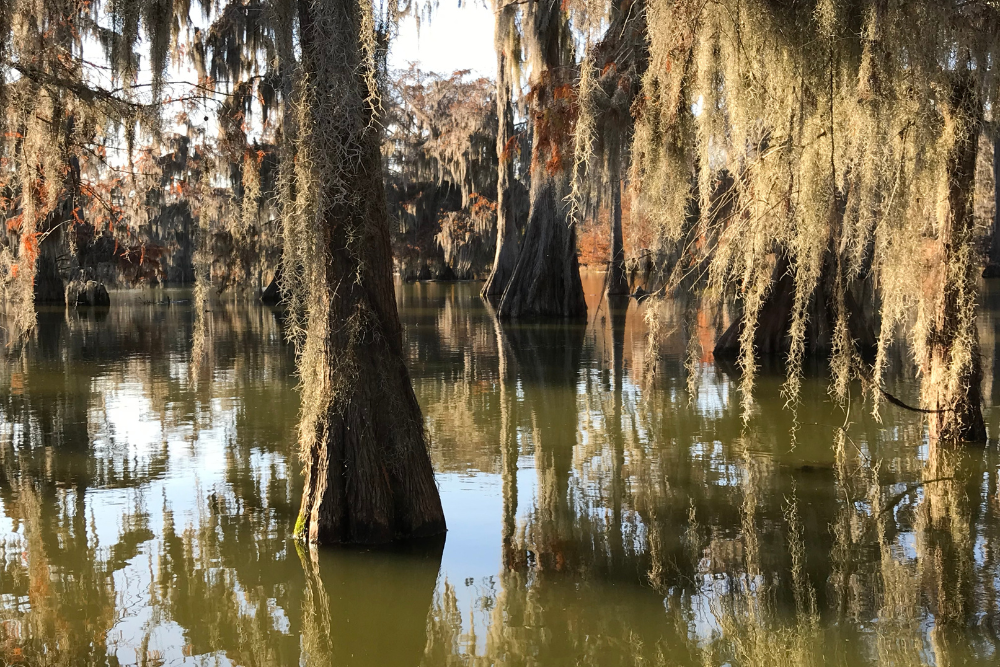
Another often overlooked destination is the drive from New Orleans to Gaveston Texas. This includes bayou country with Cypress trees growing out of the swamps which are teeming with alligators, turtles, and waterfowl. I know the bayou doesn’t typically come to mind when you think about the changing colors during the fall foliage viewing season but think again.
The swamps include huge swaths of diverse vegetation and most of it goes dormant in the winter, which results in seasonal color changes in the tree canopy and underbrush. Additionally, this drive includes the area around Galveston which is coastal and wetter than most other Texas locations so you can experience the changing scenery all along Galveston Island as well as breathtaking sunsets.
More Fall RV Routes to Add to Your Calendar
The list above describes five early leaf peeping destinations that can be (and probably should be) experienced before the full color spectacle is in full swing. These specific destinations are listed here because later in the season you might miss the change in fall foliage at these locations and you might encounter difficult or dangerous weather conditions.
But these five locations are not a comprehensive list and if you do a little internet research you will find hundreds of regional destinations well worth your time and attention. Here are a few other options that we have enjoyed through the years. Route 66 or segments of that historic highway.
Route 66 begins in Chicago and ends in LA and was originally intended to link urban “main streets” in small and mid-sized communities across all those states. It is not a well-defined continuous roadway but as you drive through small towns in those western states, you’ll see signage designating sections of roadways as part of the original route. Some of these main streets are so narrow with sidewalks and structures, (businesses and residences) so close to the road that you wonder how trucks and larger RVs can even use those roads but they do and we managed to drive on many of them in a 38’ motorhome.
Route 66 is a reminder of our historic love affair with traveling in automobiles. It was originally built in 1926 to help connect a large segment of the country in ways the rail lines could not. Hence the connection of numerous “Main Streets”. We discovered dozens of these connections while driving through Illinois, Missouri, Texas, New Mexico, Arizona, and California and you can too.
Michigan’s Upper Peninsula and Three Great Lakes in One Day
Another great destination for leaf peeping and for your general enjoyment is the upper peninsula of Michigan which is bordered on the north side by Lake Superior and on the south side by Lake Michigan. When we went there, we enjoyed breakfast, lunch, and dinner on three different Great Lakes on the same day.
Breakfast was on Lake Huron, we enjoyed lunch beside Lake Michigan, and dinner in Marquette on the south shore of Lake Superior. The whole region is rich in history and local traditions including unique foods like Pasties which are made with rutabagas, meat, potatoes, and onion, all folded into a light pastry crust. We have traveled through most of the US and Canada and have only encountered pasties on Michigan’s upper peninsula.
This article is about fall foliage not local cuisine but it’s worth pointing out that your leaf peeping trips can be rich experiences on many different levels. You can absorb the history, see and experience different wildlife, enjoy the unique foliage, learn about local customs, and even eat unique local foods that can only be enjoyed in the regional settings.
More fall foliage destinations include the bad lands of South Dakota and the countryside surrounding the Grand Canyon or even the grass lands of Wyoming. These places may have forests that are less dense than other destinations like the Great Smokey Mountains but even these evergreen forests and grasslands can have breathtaking views and wildlife.
Generally speaking, I can’t think of any part of this continent that is lacking in wonder and beauty so get your maps and calendar out so you can start planning your next RV adventure. It’s all amazing, from Gettysburg to Danali, the Everglades to the Olympic Peninsula, and all points in between. So, get out there and enjoy it.
Where else are some of the best fall foliage RV trips in the US?
The US and Canada are so vast and visually breathtaking you don’t have to drive across the continent to find exceptionally scenic fall foliage. Unless you like the long drive, and in the right RV we all know that the trip is often more important than the destination.
So, if you really want to make a long trek to distant destinations, so be it, there will certainly be more opportunities to find and enjoy amazing scenery on the longer trips then staying close to home, but the cross continent drive is not necessary.
Regardless of where your travels originate, you should be able to find exceptional scenic drives close to any US or Canadian location. If you’re starting from the west coast, the mountain states, out on the vast interior plains, or the east coast you’ll discover that you’re not too far from amazing parks, rivers, lakes, and spectacular scenery much of it will be observed in technicolor during the fall change of seasons.
I have personally driven a motorhome over 130,000 miles all over the North American continent and have seen many of these amazing vistas and wonders, first hand. These suggestions are not a comprehensive or exhausting list of wonderful destinations, just a few recollections that sprang to mind when I considered the title of this blog post.
In the west you could enjoy a scenic drive along the Pacific Ocean, or go to Joshua Tree National Park in southern California, or visit the North Cascade National Park in Washington, or take your time and drive the entire Oregon Coastline with spectacular views of the coastal waters and communities.
You can even see migrating gray whale from many convenient overlooks and parks. The coast’s fall colors are not as dramatic as some other parts of the country but the scenery will not disappoint. If you’re looking for stunning fall colors on the west coast, try driving the Mt. Hood loop through Hood River Oregon which will include driving through a portion of the Columbia Gorge which is stunning in its own right.
But if you’re determined to experience the full effect of the changing fall colors, there’s no better place to see this than the
Great Smokey Mountains, in Tennessee and North Carolina. The Great Smokey Mountain National Park is the most visited National Park in the US. The peak of the seasonal color change is the most popular time to visit this park, so be prepared for the crowds.
The upper peninsula of Michigan is also a lovely place to see the change of color, but be advised that winter can sneak up on you that far north, so pay attention to the weather forecasts. Bayou country, in Louisianna and Mississippi can also be a scenic destination with surprising color shifts, and don’t miss the Shenandoah Mountains in Virginia. There are scenic destinations along the Missouri and Mississippi Rivers, plus in South Dakota, Wyoming, Utah, Wisconsin, and Montana which are all packed with parks where you can experience all the wonders of the fall foliage season.
Recommended Scenic Destinations
Shenandoah Mountains, Virginia
Columbia Gorge, Oregon or Washington
New Orleans, Louisiana to Galveston, Texas
Great Smokey Mountains, Tennessee or North Carolina
Glacier National Park and Tetons Wyoming and Montana
Upper Peninsula, Michigan
Other Options;
Route 66, Chicago to LA
Adirondacks, New York
Zion or Bryce Canyon, Utah
Badlands National Park, South Dakota
Acadia National Park, Maine
How long does fall foliage season last?
The answer to this question depends on the location and regional weather patterns, but it’s safe to say that the most spectacular display of color is usually limited to a couple of weeks not a couple of months. Also remember that the higher the elevation the earlier the leaves will begin to change color. If you watch time lapse photography of a hillside during the fall you will actually witness the color descending the slope into the valley below. It’s predictable but the precise timing is hard to determine because it is controlled by changes in the regional temperature. Therefore, planning ahead for your leaf peeping journey is important. For example, Pigeon Forge which borders Great Smokey Mountain National Park sells out completely during the peak season. If you’re set on visiting this park to see the fall colors, check with local authorities for their prediction of when the change will occur. Try to schedule weekday visits rather than arriving on a weekend. Also, you might consider visiting the park in the spring or summer rather than the fall to enjoy spectacular firefly exhibitions or to hike one or more popular back country trails to see the local wildlife and numerous waterfalls. Typically, October is the best month for leaf peeping but the optimum week for viewing changes from year to year. Park staff do try to predict the peak viewing season, so people can plan ahead, but any unanticipated change in the weather could render their predictions moot.
What’s the best time to see fall colors while RVing?
Whether you’re visiting the Grand Teton’s National Park or the Great Smokey Mountains National Park, or the Columbia Gorge the best time to see the fall colors is generally in October. It’s called the shoulder season, and it is generally one of the best times to enjoy RVing. Summer is over, but winter hasn’t set in, school is back in session, and most vacations are over, so there’s less traffic and congestion in parks and campgrounds. For the most part the weather is still mild in October and that combined with less traffic and congestion makes it the ideal time to go RVing and it happens to coincide with the change in fall colors so that makes October the best time to see the fall colors.

Keep you and your RV Safe While on the Road
Weather-Proof Your RV: Preparing for Spring Storms

Unpacking 2023’s Impact on the RV Industry