
Understanding the 5 Main RV Classes: The Ultimate Guide

You’re probably new to RVing if you’re reading this article because one of the very first things you need to grasp about RVs is an understanding of the 5 main RV Classes, and people who have been RVing for some time are already familiar with these distinctions. But when you’re first starting out, it’s impossible to compare, or shop, or even consider owning an RV, without first knowing what types are available, how they differ from each other, and which type might be best for your camping needs, family size, and budget. Before we break down the 5 main RV classes, be assured that you can find a wide assortment of both new and used RVs in each class and all RV classes have a wide range of prices. Therefore, to get the right RV for your needs try to focus on the distinctions of each class, and not just the price tag.
I remember when we first started thinking about RVing, the 5 main RV classes and everything else about RVing was a complete mystery. It was the late 90’s so we didn’t have all the online resources that are available to you, today. Like you, however, we had a million questions but the only way to get answers was to search for books about RVing, but Amazon books, Google search, and blogs didn’t even exist at that time. Our main source of information came from people at RV shows or dealerships, but we had to piece the information together like a patchwork quilt. We didn’t even have enough basic RV knowledge to ask intelligent questions. If you’re in that same place, I hope this helps. You’re already way ahead of where we were, because you’re on a website where you can browse through hundreds of listings of for-sale-by-owner RVs in each of the 5 main RV classes and read helpful and insightful blog posts from many experienced RVers.

The 5 Main RV Classes Explained
The 5 main classes of RVs are …
- Class A
- Class B
- Class C
- travel trailers
- 5th wheel trailers
But before diving into the differences in these 5 main RV classifications it’s important to understand that all RVs fall into one of two even broader categories. RVs are either self-propelled (have an engine) or they must be towed by another vehicle with an engine. This distinction may seem obvious, but this one characteristic will ultimately define (or at least inform) your search for the perfect RV. Within each of these two categories you’ll find many different RV types, sizes, prices, and brands, but ultimately your desire to drive your RV, or tow it, will dictate which main class of RV will best meet your needs.
Drivable RVs
Within the category of drivable RVs there are three general RV classes; they are Class A and Class C motorhomes and Class B vans. All three of these types of RVs can be purchased with either a gas or diesel engine and they come in a host of sizes and sleeping arrangements. For example, you could purchase a 40 foot Class A motorhome that only has sleeping space for two people, or you could purchase a 26 foot van that sleeps six. The prices within the drivable RV category ranges from $30,000 to over a million dollars, and there are brands, amenities, and floor plans for virtually every camping need and budget.
Motorhomes
Class A
Class A Motorhomes are one of the 5 main RV classes. These RVs are the large boxy RVs with the flat front end. They have huge front windshields with the driver’s compartment located at the very front right over the front tires. Believe it or not the large front windshield is one of the advantages of a Class A motorhome. The large window provides more light on the inside of the RV and gives you an unobstructed view of the great outdoors. After all, isn’t being in the great outdoors one of the reasons you’re interested in RVing? Of course, when you’re camping in an RV you can spend most of your time outdoors but it’s also nice to have a great view from inside your RV if the weather isn’t cooperating.

You can purchase a Class A motorhome with a gas or diesel engine. Diesel engines in a Class A motorhome are in the rear of the RV therefore these RVs are often called a diesel pusher. Gas engines in a Class A motorhome are located between the driver and passenger seats at the front of the RV. There are other more significant differences between gas and diesel Class A motorhomes besides the location of the engine, including engine power, longevity, and resale value, but the most obvious difference is the cost differential between these two types of engines. Since diesel engines last longer and have more power they also cost more. The pros and cons of gas vs diesel is a heated debate within the RV community, and you’ll find passionate advocates for both types of engines whether you’re discussing a Class A, Class C motorhome, or a Class B van, but I won’t go down that rabbit hole in this article. I broke down this debate in an RV Life article and if you want more information about the pros and cons of gas vs diesel engines you can read more here.
Class C
Class C and (Super C) Motorhomes are the second type of the 5 main RV classes. These RVs are much like Class A RVs but the engine is located in front of the drivers compartment not between the seats so they have a protruding engine compartment that is visible from outside the vehicle. They also generally have a sleeping compartment over the top of the driver’s area which is also visible from the exterior. Those two features greatly reduce the size of the windshield and the clear view to the front of the RV from the inside. But many people prefer this arrangement because they feel that driving a Class C RV feels more like driving a pickup truck rather than a huge motorhome. Class C RVs have a broad price range, many different brands, floor plans, and sleeping arrangements. Historically, most Class C motorhomes were built with gas engines but now you can purchase a Super C motorhome with a diesel engine in place of the gas engine. These RVs are sometimes called “diesel pullers” as opposed to the Class A version which are “diesel pushers”. Both Class A and Class C RVs have been and continue to be wildly popular in the RV community. The amenities and appointments in these rigs continue to evolve and now you can buy motorhomes with multiple bathrooms, extra high ceilings, home style side by side refrigerators, convection ovens, a washer and dryer, fireplace, sleep number king bed and much more. Many new models cost over 1 million dollars, but there are used Class A and Class C RVs for sale on this site for as little as $30,000.
Conversion Vans

Class B
Class B Motorhomes (also called a conversion van) are the third type of the 5 main RV classes and vans are the last of the three drivable RVs. Just like a motorhome they have an onboard engine that uses either gas or diesel fuel. Many conversion vans are a simple adaptation of a commercial cargo van with minimal camping features, while others have been extensively modified to support an outdoor camping lifestyle. Many have a fully functional galley with a refrigerator, convection oven, stove top burners, and sink which is connected to a freshwater tank and gray water holding tank. They’re wired for both shore power (AC power that is provided in a campground) and DC power which is generated by solar panels, stored in batteries, inverted from DC to AC power, and routed throughout the van. Many of these more elaborate vans even have a wet bath (which is RV speak for a toilet, sink, and shower in a ate bathroom enclosure).
Class B+ Vans are a subcategory of Class B van class. They are more elaborate and generally larger van conversions with more amenities and features. Class B+ RVs usually have one or more slide outs to increase the interior living space in the RV. They have a compartment over the cab which is either used as storage space and/or as an entertainment center, unlike Class C RV’s which typically use the over-cab space as an additional bed. As Class B+ vans get bigger and more elaborate they start to resemble Class C campers more and more. But don’t be fooled, just because vans are generally smaller than their Class A and Class C drivable counterparts they are not less expensive. In fact, many of the Class B and B+ RVs are priced the same or even higher than comparable motorhomes. One salesperson explained this phenomenon to me by reminding me that it’s harder to pack all those features into smaller spaces and all other RVs are built from the chassis up so wiring, plumbing, and appliances can be installed before the walls are in place which is easier and faster.
Van conversions (both Class B and Class B+) are gaining in popularity even at the higher price point and the main draw is their maneuverability. A van conversion can go almost anywhere a pick-up or car can go. They can easily manage back country roads, and some are even sold with 4-wheel drive for those really off-the-beaten-path hidden camping destinations. But when you finally arrive you have all the amenities of a fully functional RV; bed, shower, kitchen, freshwater tank, gray and black water holding tanks, solar power, and so much more. Driving to your destination is like driving a car with no worries about low overpasses or weight restrictions on a bridge. The gas mileage is better in a van conversion than any other drivable RV and you and your rig will easily fit in the smallest forest service campsite or boondocking location.
Towable RVs
Not all RVs have an onboard engine and the final two RV types of the 5 main RV classes need an external power source to move them from one place to another. The biggest advantage to these types of RVs is that you don’t use any of your livable space for the power source and towable RVs are generally less expensive than drivable RVs because you’re not paying for the engine and all the supporting systems that go into a drivable RV. However, you will still need to have the truck, SUV, or car to tow your RV. And the larger the towable RV the larger and more powerful your towing vehicle will need to be. If you already have a truck that can be used for towing then you can take advantage of this huge price difference but if you don’t have a vehicle with enough horsepower to tow an RV and you need to buy the towing vehicle at the same time as the RV the price difference between drivable and towable campers all but disappears.

However, there is one other very important difference between towing or driving an RV. With a motorhome or van if you don’t have a separate drivable vehicle (motorcycle, bicycle, or towed car) you’ll need to break down your campsite every time you want to go sightseeing or go to a store or restaurant. Not having a separate vehicle limits your range of activities and experiences. With a towable RV after you get your campsite set-up you can use the towing vehicle to go sightseeing or to drive to nearby attractions. Most people who buy a motorhome also quickly learn that they also need a separate tow vehicle too. Therefore, if you factor in the cost of a towed vehicle with the cost of a motorhome the cost differential still favors towable trailers even with the expense of buying a truck to tow the trailer.
Travel Trailers
These are the fourth type of the 5 main RV classes and are probably the most popular type of RV. They come in a vast array of styles, floor plans, lengths, brands, appointments, sleeping quarters, and price points. There are micro trailers that can be towed with a small sedan or 40 foot trailers that must be towed with a heavy duty truck. The one thing they all have in common is the type of coupling device that attaches it to the towing vehicle. In virtually all cases, travel trailers are attached to the towing vehicle with a standard trailer hitch or bumper mounted ball hitch. Also accompanying the ball hitch are safety chains, a power cord (for the lights and brakes), and most people also use anti-sway bars to help the trailer follow precisely behind the towing vehicle. Anti-sway bars keep travel trailers from fishtailing in high winds or during sharp driving corrections. All these attachments are important and in one case the safety chains between a pickup truck and a travel trailer were the only thing that kept an elderly couple and their dog from plunging hundreds of feet to their death as they dangled off the side of the bridge over Hells Canyon on I-84 between Oregon and Idaho.
Fifth Wheel Trailers
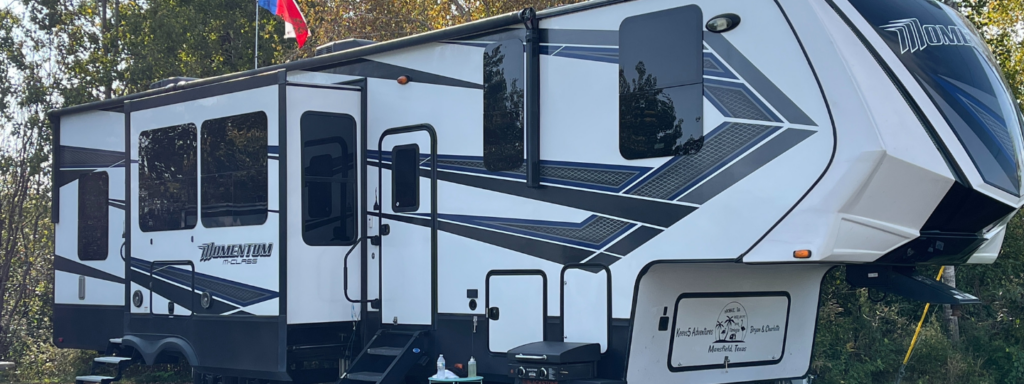
Fifth Wheels are the fifth type of the 5 main RV classes and like a travel trailer offer a huge assortment of floor plans and amenities. Some of the larger fifth wheel trailers have one or more exterior patios, with one patio on the side and one at the rear. Many fifth wheel trailers are also toy haulers although you can find toy hauler features in some travel trailers and in a few models of motorhomes. However, the toy hauler feature is most prevalent in fifth wheel trailers. The inside creature comforts of a fifth wheel trailer may include bunk beds, multiple bathrooms, a fireplace, a free standing island in the galley, multiple entertainment centers, outdoor TV, an outdoor kitchen, and so much more. Fifth wheel trailers are wildly popular among RVers and are often the 1st choice of people who travel for their occupation, like traveling nurses.

The primary difference between a travel trailer and a fifth wheel is the coupling device used to attach it to the towing vehicle. As stated above travel trailers are considered bumper pull trailers, while fifth wheel trailers use a pin latch system similar to those used on semi-trucks and trailers. The latch is mounted in the bed of a pick-up truck, and it attaches to a ball that extends downward from the portion of the trailer that is engineered to overhang the truck bed. This coupling device is generally considered to be more secure and stable than a ball hitch and does not require anti-sway bars. Additionally, fifth wheel trailers have a different general floor plan than travel trailers because of the extension that overhangs the bed of the truck. Fifth wheel trailers are easily backed up and maneuvered within a campground or in your driveway or storage facility. But unlike small light travel trailers, fifth wheel trailers cannot be towed with a car, or SUV and they are typically larger than the average travel trailer. Just like large travel trailers, fifth wheel trailers require heavy duty towing vehicles, which adds more expense to your RV package, (trailer and towing vehicle.) But unlike motorhomes, there is no need for an additional vehicle in which to see the sights. Once you get your fifth wheel set-up you can just use the truck for activities away from your campsite.
Truck Campers are in a category by themselves and as such are a bonus to the 5 main RV classes but they should not be overlooked as an optional RV choice. These RVs don’t have an axel or wheels and they are literally hauled on the back of a truck to a campsite. As long as they are mounted on the truck they are part of the truck (as far as insurance is concerned) but truck campers can easily be removed from the truck and left on the four legs that come standard with these unique campers. Like a travel trailer and a fifth wheel the truck that transports it to the campsite can then be used for sightseeing. Truck Campers are smaller than a fifth wheel trailer and generally smaller than most camping trailers (with the exception of teardrop trailers or micro trailers) but they still offer a full range of RVing amenities like lounge chairs, a dinette, kitchen, a fixed bed, slide out walls, holding tanks, bathroom, and other creature comforts.
Know the Basics
Understanding the basic differences between the 5 main RV classes plus the bonus truck camper will help you decide what type of RV will meet your needs. Ask yourself, how often you intend to camp, how many people will be using the RV and in what way? Do you have a desire to explore the back-country and camp in remote boondocking locations? Do you need space for home-schooling your children? Do you want to be a full-time traveler and camp in an RV 365 days a year? Do you need to use your RV as a basecamp for traveling employment? Are you comfortable driving an RV or towing and backing one? Will you need a toy hauler to transport extra equipment in your RV? And finally, what is your budget for this new adventure? My advice is to learn all you can from people who have been RVing for decades, take your time to learn as much as possible. Study the forums and find out what people are saying about different RV classes and brands. Take your time to pick out the right type of RV, the right brand, and the right floor plan, to meet your unique needs. The more effort you put into this research process the more likely you’ll find the perfect RV that meets all your needs. And when you’ve done your research and are ready to start shopping for your RV you’ll find all 5 of the main RV classes here at National Vehicle, so bookmark this site.


Upsizing or Downsizing: Should You Sell Your RV Before Buying the Next One?

Buy An RV Fearlessly, With These Tips

The Different Types of RVs