
RV Insurance Explained: What’s Covered and What’s Not


There are many components to RV Insurance that you should consider and evaluate before you acquire a recreational vehicle of any type, and don’t be fooled into thinking your regular homeowner’s insurance and/or auto policy will extend to your RV and cover any losses. Below you will learn five key things about RV insurance including what types of insurance are necessary and applicable to an RV and how different RV types require different insurance coverage.
Different Types of Insurance Cover Different Risks:
There are basically three categories of risk or loss that are covered by most RV insurance policies. These three categories are much like what you would purchase for an auto. They are collision, comprehensive, and liability. In addition to these three, a fourth type of coverage covers higher risks and it’s called an umbrella policy.
Each of these may or may not be part of your specific policy and all have unique restrictions, deductibles, and limits of coverage. Here is a list of the applicable types of RV insurance and what each does.
- Collision pays for damages to your vehicle in an accident.
- Comprehensive pays for damage to your vehicle due to anything other than a wreck, like hail or wind damage, theft, or vandalism, but it does not cover repairs or damage to your RV that may be caused by wear or a defect. (See extended warranty below.)
- Liability pays for injuries to you or damages to your RV caused by other people and not covered by their insurance. Also, liability insurance covers other people’s losses when caused by you.
- Umbrella pays higher liability claims and applies to claims after all your other coverage has been exhausted. This insurance extends your liability coverage to whatever limit you choose: 1 million, 2 million, or more. There are stipulations associated with this coverage that defines what your minimum liability coverage must be with your primary liability policy. Of course, this makes sense because the umbrella policy only applies to losses that exceed the limit of your primary liability coverage.
Separate Insurance Coverages Are Usually Wrapped Into One Policy:
Even when people live full-time in their RV and it becomes more of a house than a vehicle, their RV insurance still follows the basic structure of an auto policy rather than a homeowner’s policy. Regardless of your intended use of your RV, never assume that your homeowner’s insurance or auto insurance extends to every type of incident involving your RV. For example,
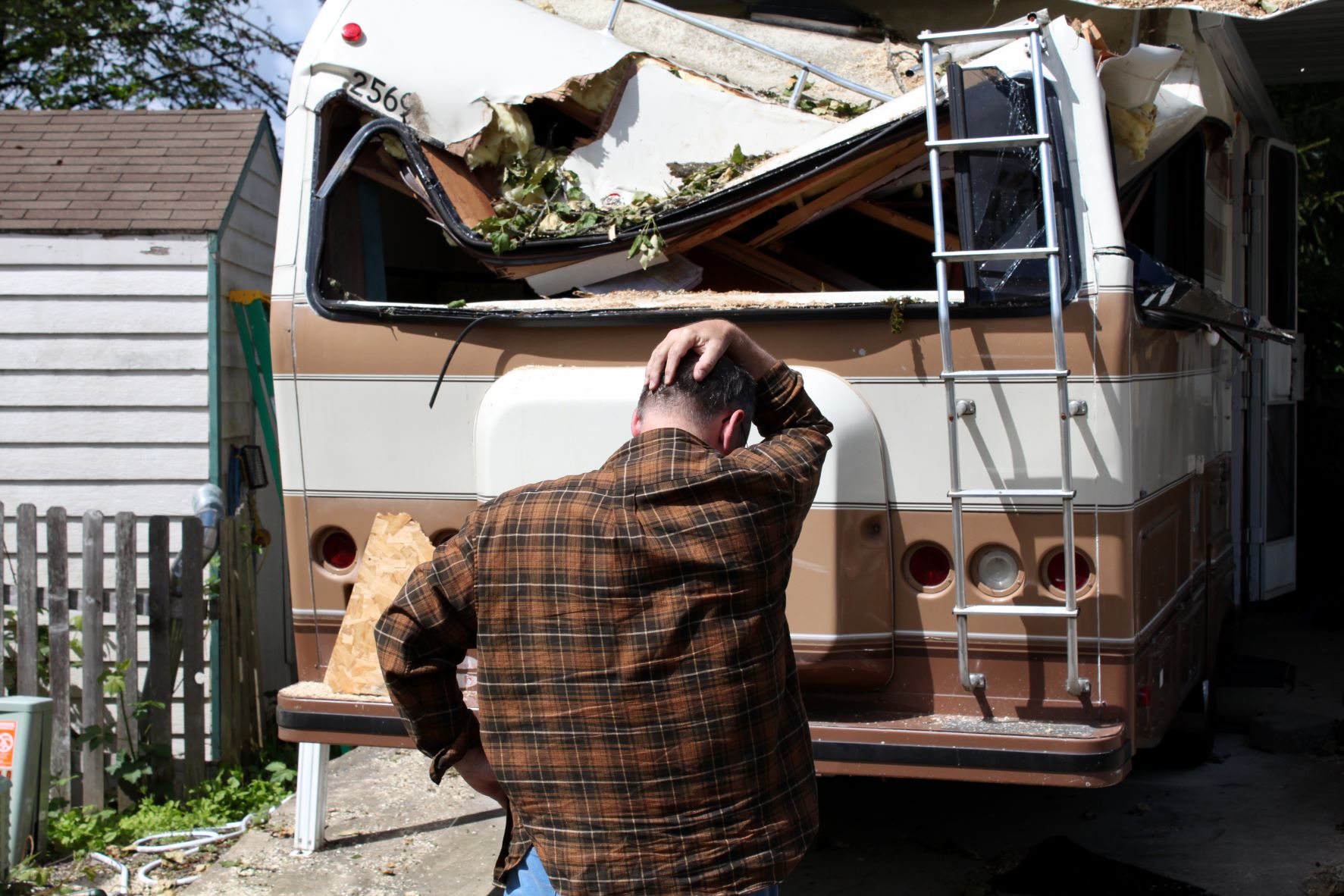
- If a huge tree branch falls on your RV while it’s parked in your driveway your homeowner’s insurance will most likely cover the damage.
- If a tree branch falls on your RV while it’s parked in a campground, you’d need comprehensive RV coverage to pay for that damage.
- If your RV tears a huge branch off of your neighbor’s prize cherry tree then RV collision and liability coverage will be needed to pay for the damage you caused to the tree and to repair your RV.
Even if your auto and/or homeowner’s insurance covers some losses associated with your RV, you will still need to raise the limits of those polices to make sure all your assets (including your RV) are fully protected. The best way to make sure you have all the right coverage, with the right deductibles and loss limits, is to talk to your insurance agent prior to purchasing your RV. But before contacting your agent please follow the steps in point 5 RV Insurance Shopping Tips, described below. Your agent will need to know
- the type of RV you intend to purchase,
- the value of that RV,
- how you intend to use it (weekend outings, multiple extended vacations, full-time RVing)
- and where you will park or store your RV when not in use,
All of these factors will be used to determine the best type of insurance and what deductibles meet your particular needs.
As a separate point of interest, if you intend to store your RV in the off season, be sure to ask your insurance agent if you can discontinue coverage in the winter months. Being able to activate and deactivate your insurance coverage, could save you some money. But if you temporarily pause your insurance coverage while your RV is in storage and it is vandalized or stolen during that period of time, none of your losses will be covered, so be sure to evaluate all the risks before pausing your coverage.
The Same Coverage Does Not Apply to All Types of RVs:
There are many different types of RVs such as motorized RVs like class A, B, B+, and C motorhomes, and there are towed RV’s, such as a travel trailer, 5th wheel trailers, and pop-ups, and there are RVs that are mounted to a truck called, truck campers. Each of these RV types have different criteria for insurance coverage.
For example, a travel trailer will be covered under the liability coverage of the vehicle that is towing it, but only while the trailer is being towed. The same is true for truck campers that are mounted to trucks at the time of a loss. As an example, if you damaged the roof of a campground’s check-in kiosk by driving your truck camper, or trailer under the extended awning of the building, (and how many of these damaged check-in building have we all seen) the damage caused by your camper or trailer to the building would be paid by your truck’s liability coverage.
In that situation there is no need for a separate liability policy for the camper or trailer. In a different scenario, if the neighborhood kids are playing with your kids in your truck camper when it is disconnected from your truck and one of the neighbor kids is injured, the liability insurance for your truck would not extend to the camper because it was disconnected from the truck, at the time of the injury. The child’s injuries would not be covered by your auto policy and unless your homeowner’s insurance covers that scenario, you would be personally liable for the cost of the child’s injuries.
For motorized RVs you will probably need to purchase all three types of coverage; liability, comprehensive, and collision insurance, and correlate each type of coverage with the actual value of your motorhome. Depending on your financial situation and your tolerance for risk, you may also want to purchase an umbrella policy to further protect you from lawsuits associated with injuries or damage suffered by other people that was caused by you while in your motorhome.
The way my insurance agent explained the umbrella policy to me is that a motorhome is a heavy vehicle which can do a great deal of damage in a wreck. People may be seriously injured, and property destroyed in a wreck with a vehicle that weighs more than 13 tons. Medical bills quickly mount up and may exceed the maximum coverage limit of the primary liability coverage.
If that were to happen, God forbid, the injured parties might seek to recover their losses through a lawsuit and an umbrella policy just extends the limit of loss to a much higher level. There’s no insurance plan that will eliminate all risk, but having adequate liability, and collision insurance will go a long way to reducing other people’s losses, as well as your own.
An Extended Warranty is Not an Insurance Policy:
Many people confuse an extended warranty for RV insurance. Insurance and warranties offer completely separate types of protection, and in many cases both types of protection are needed. If you have an extended warranty, it may give you some peace of mind like having insurance but unlike insurance which you can pay for as you go and cancel at any time, an extended warranty is paid up-front, is for a predetermined length of time, and every claim must be pre-authorized before any repairs are made.
An extended warranty covers all types of malfunctions in the parts and systems of an RV, and most warranties also cover secondary damage that may result from those defective parts or systems. In the sections above you learned that comprehensive insurance covers things that could damage your RV other than a collision. For example, comprehensive insurance covers the branch that falls on your RV in a campground, which results in water damage to your flooring, but it will not cover damage to your RV if the water heater hose leaks and your entire RV is flooded.
That defective part and the secondary damage caused by the defective part would be covered by the original warranty on your RV. If the original warranty has expired, then the only thing that would help offset the cost of those repairs would be an extended warranty.
The costs and the coverage limits of an extended warranty depends on the age, and type of your RV, and it would be prudent to shop carefully for extended warranty coverage, if you want to purchase that extra protection. If you investigate this subject on the iRV2.com forum you can read passionate accounts from people who swear extended warranties are a great bargain, and others who think extended warranties are a waste of money.
Fortunately, the merits of an extended warranty exceed the scope of this discourse, (thank God, because I don’t want to wade into that quagmire). Whether you are pro extended warranty or against them, you need to understand that extended warranties are not insurance, and each financial instrument covers different risks, losses, and damages.
More RV Insurance Shopping Tips:
When you’re ready to buy an RV, and you’re in need of RV insurance, I recommend doing some research in the iRV2.com forum, then check out online RV insurance underwriters, (find links to many below). By doing research online you’ll learn what types of insurance you’ll need for the specific type of RV you intend to purchase, and you’ll have a better understanding of the loss limits and deductibles that are applicable to each of those types of insurance.
After you have a general idea of what you need, and what you might have to pay for that insurance, then you could ask your regular insurance agent for a quote. You will already know approximately what that coverage will cost, and perhaps your agent will be able to bundle your RV insurance with your homeowners and/or auto insurance policy and save you some money. Additionally, your agent may be able to arrange for active and inactive periods of coverage depending on your seasonal use, which could also reduce your overall costs.
You might expect to pay from $300 to $3000 annually for RV insurance depending on the type of RV, the RV’s value, the type of insurance, loss limits, and deductibles of each coverage type. In addition to the annual cost of insurance, an extended warranty could also cost many thousands of dollars more and as stated earlier it is typically paid in-full at the beginning of the coverage period.
If you’re buying an RV from a dealer, the dealer may offer to roll an extended warranty and even RV insurance into your financing package but that might be the most expensive way to obtain both. It may be convenient but it could be much more costly. And I suggest that you do more research before packing it all into a long-term repayment plan. After all, the cost of a 5- or 10-year extended warranty would be wrapped into your monthly RV payments for the duration of the loan (which could be 30 years) so you end up paying for an extended warranty for 20 or 25 years after the extended warranty expires.
Regardless of what type of RV you buy and how you buy it, in the end you will also need to purchase RV insurance and the links below will provide more information about this very important decision.
Frequently Asked Questions:
What is Full-Time RV insurance and when do I need it?
Full time insurance should not be confused with full-timer RV insurance. The first simple means that RV owners should have RV insurance for the full time they own the RV. While the second type, full-timer RV insurance refers to a particular type of use of that RV by people who use their RV day in and day out, as a substitute for a fixed residential structure.
There people are considered full-timers. Many full-time RVer are retired continuous travelers. Others are work campers who may own a residence but use their RV as a residential substitute near a remote work site. Traveling nurses and construction workers are examples of work campers. The insurance for full-timers, takes into account this extended use and adjusts the policy costs to reflect the increased risks.
Full-time RV insurance combines elements of homeowner policies with elements of auto insurance to create a hybrid policy to cover full-timers. You would only need full-timer RV insurance if you live full-time in an RV.
Is my RV covered for damage from mold, mildew, or rot?
Generally speaking, the damage from environmental factors like mold, mildew, or rot would not be covered in a typical RV comprehensive policy. However, if the mold or rot was a secondary result of a covered event like a leaky connection in the shower, an extended warranty might cover the costs of the repair but RV insurance would not cover either the defective water connection or the damage that resulted from that connection.
If however, the mildew or rot was identified as secondary damage resulting from a covered wreck of the vehicle then that secondary damage would most likely be covered by an RV insurance policy.
Does RV insurance cover mechanical breakdown or engine failure?
Mechanical failures would not be covered by your RV insurance but if the brakes failed and it resulted in a wreck the RV insurance policy would cover the damages resulting from the wreck. If you or your vehicle (like brake failure) are the cause of a wreck the damages suffered by others would be covered by your liability insurance and the damage to your own RV would be covered by your collision insurance.
RV Travel Budgeting for 2025 Spring and Summer
RV Coverage Mistakes To Avoid

The Best National Parks to Visit Before Summer